
Compressor Fridge Conversion - A Year Later

We’ve been running with our fridge conversion for over a year, so more than enough time has passed to report on our overall experience.
If you haven’t read Part 1 and Part 2, please do so. This post will make a whole lot more sense if you do!
How Has It Worked?
Well, put simply, it’s just worked. Perfectly.
This conversion has removed all worries of arriving at an ‘off grid’ CL and not being able to light the fridge on gas (which, if you read part 1 and 2 was the whole reason this project commenced). It’s also removed the inefficiencies when (sort of) powering the fridge on 12v when towing. The cider and wine is now stone cold when we get to site and there is ice in the ice-tray (which would have been a lottery on a long journey).
Has Anything Been Changed?
There’s been one addition and that is a grill-like door on the freezer compartment. I mentioned the intention of doing this in Part 2, and made one out of an old plastic coated wire shelf from a domestic fridge, some off-cuts of 25mm x 12.5mm aluminium box tubing and 3D printed corners. This mounts using the hinges from the original freezer door and does the job admirably.
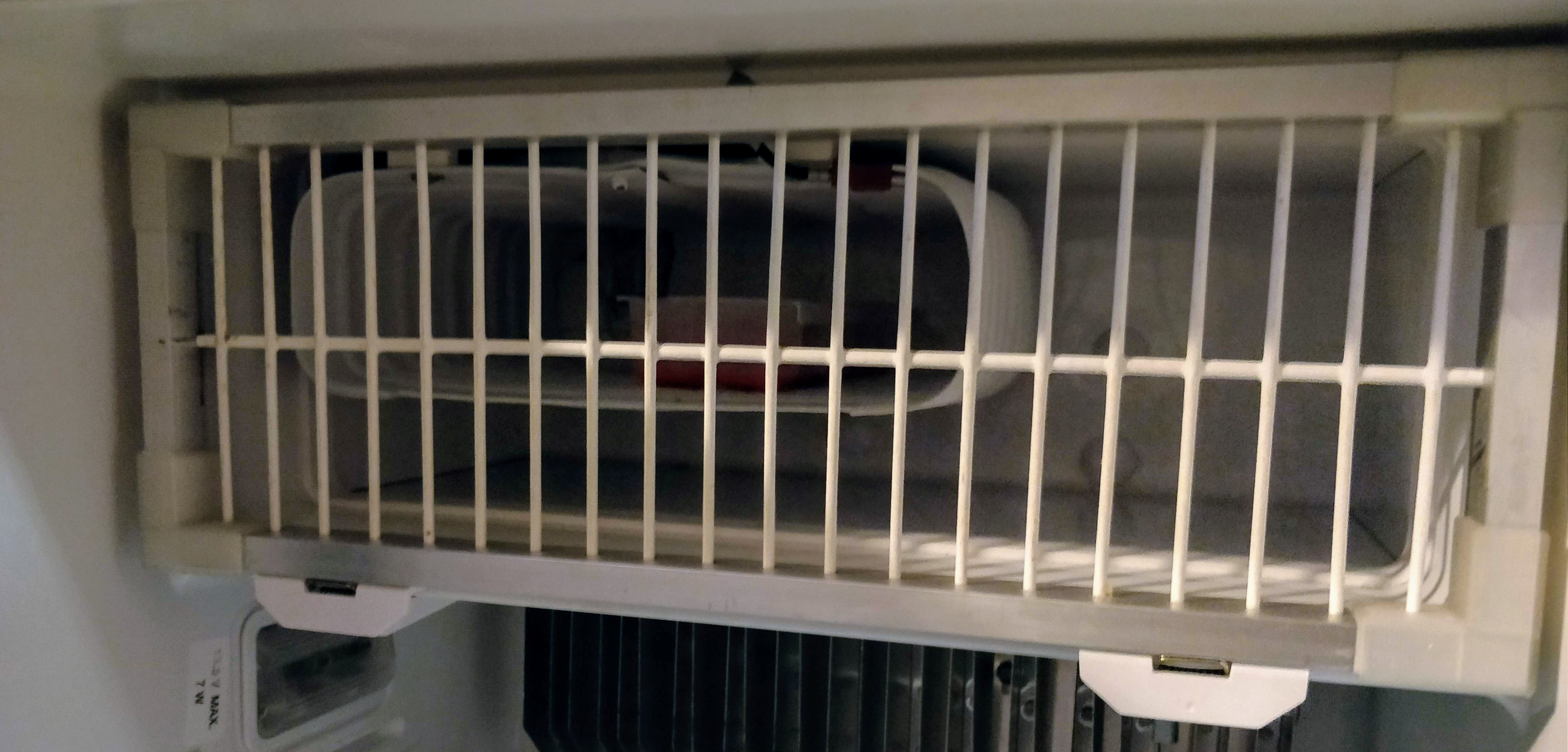
Apart from that, there have just been a few ‘tweaks’ to operation. We’ve kept the target temperature of -12 degrees but have halved the slew to 5 degrees. This means the evaporator temperature never gets above -7. On extremely warm days this ‘little and often’ mode of operation seems to be more efficient than the previous 10 degree slew.
No other changes to operation have been made.
We’ve only actually been totally off-grid for two weekends during 2019 but, wherever possible, we’ve not used mains electricity, except to power the microwave. This was completely intentional because we needed to know if it was possible to be completely off grid for extended periods.
Just relying on a 120w solar panel and 110ah leisure battery to supply all electrical needs can concentrate the mind but, just by being more wary of power consumption has proven that our installation can provide everything we need when away from a mains supply.
A compressor fridge is actually an ideal match for solar. It obviously consumes more power when it’s hot outside but this is balanced out by there being more sunlight. At the height of summer (when it was 32 degrees), some rough timings saw a 50% duty cycle of the compressor, drawing around 4amps. Basic maths shows that a 110ah leisure battery alone could run the fridge for over 2 days at that rate. But, that duty cycle is typically much lower and even on the warmest of days, the temperature reduces overnight and the duty reduces.
We obviously run other stuff of the leisure battery. Laptop, phone, tablet, Kindle, MiFi and camera chargers. The radio (which is on all day if we are ‘resident’) and obviously all lighting. We don’t however have a TV. During the course of 2019, we have never had the battery under 12.2 volts even after several rainy days. For the uninitiated, a leisure battery at 12.2 volts is still around 50% charged.
Things we do to manage our power usage:
- Charge a usb power bank during the day. This is then used to charge/power our phones during the evenings.
- Changed all lighting to LED.
- Keep laptops/tablets/cameras topped up during the day.
- Make sure that the fridge is stocked during the day - adding ambient food/drinks increases the duty cycle so if it’s during daylight hours, minimises power loss.
- Turn things on only if they are needed.
It’s all basic common sense but our modern lives typically make us careless about such things!
As mentioned in the previous instalments, although relatively straightforward, this exercise was not for the faint hearted and is definitely not for everyone. In our case however, it has been extremely successful and has been of great benefit.


Comments